AICAR
AICAR (Acadesine, 5-Aminoimidazole-4-Carboxamide Ribonucleoside)
Research Hub — Aggregated Studies
MedTech Research Group aggregates published research from peer-reviewed journals, clinical trials, and academic institutions. We do not conduct original research. All studies cited below are the work of their respective authors and institutions. Sources are linked for verification.
This product is designated FOR RESEARCH USE ONLY (RUO). These compounds have not been approved or cleared under 21 U.S.C. § 505 and have not been evaluated by the FDA for safety, efficacy, or labeling for clinical, diagnostic, or therapeutic use in humans or animals.
MedTech Research Group will only fulfill orders to qualified researchers affiliated with accredited academic institutions, licensed research facilities, or organizations with active IRB/IACUC oversight.
Purchaser Restrictions
- Purchaser must be a qualified researcher at an accredited institution or licensed research facility
- This product may not be sold or redistributed to individual consumers, wellness clinics, health food stores, or retail establishments
- Not intended for human or animal consumption, diagnostic use, or therapeutic application
- Institutional affiliation and research purpose will be verified prior to order fulfillment
Distribution is limited to qualified research use in compliance with applicable federal and state law. These products bear the "For Research Use Only" designation per FDA labeling requirements (minimum 10 pt. font). Ref: 21 U.S.C. § 505; FD&C Act § 201(p) (unapproved new drug definition).
| Risk Tier | YELLOW |
| Category | Weight / Metabolic |
| Subcategory | Exercise Mimetic / AMPK Activation |
| Pharmacological Class | Small Molecule (nucleoside analog, not a peptide) |
| Subclass | AMP-Activated Protein Kinase (AMPK) Activator |
| Molecular Type | Adenosine analog (5-aminoimidazole-4-carboxamide-1-beta-D-ribofuranoside, also known as acadesine or AICA riboside) |
| Origin | Synthetic nucleoside analog — originally developed for cardiac ischemia research |
| Regulatory Status | Research Use Only. Not FDA-approved (Phase 3 trials for cardiac surgery were conducted). Banned by the World Anti-Doping Agency (WADA) since 2009. |
| Route of Administration | Subcutaneous injection, intravenous (research) |
| Reconstitution | Lyophilized powder; reconstitute with bacteriostatic water |
| Storage | Refrigerate (2-8°C) |
Chemical Properties
| Molecular Formula | C9H14N4O5 |
| Molecular Weight | 258.23 g/mol |
| Exact Mass | 258.09641956 Da |
| InChI Key | RTRQQBHATOEIAF-UUOKFMHZSA-N |
| Synonyms |
|
| PubChem | View full record |
Source: NCBI PubChem — public domain data
Bioactivity Data
23 assay results from ChEMBL CHEMBL1551724
| EC50 | 100.0k nM | Felid alphaherpesvirus 1 | Felid alphaherpesvirus 1 |
| EC50 | 100.0k nM | Human alphaherpesvirus 1 | Human alphaherpesvirus 1 |
| EC50 | 100.0k nM | Human alphaherpesvirus 2 | Human alphaherpesvirus 2 |
| EC50 | 100.0k nM | Human alphaherpesvirus 1 | Human alphaherpesvirus 1 |
| EC50 | 100.0k nM | HCT-116 | Homo sapiens |
| EC50 | 100.0k nM | Unchecked | — |
| EC50 | 100.0k nM | HCT-116 | Homo sapiens |
| EC50 | 100.0k nM | HCT-116 | Homo sapiens |
| EC50 | 100.0k nM | HEK293 | Homo sapiens |
| IC50 | 250.0k nM | HeLa | Homo sapiens |
Data from EMBL-EBI ChEMBL. CC BY-SA 3.0.
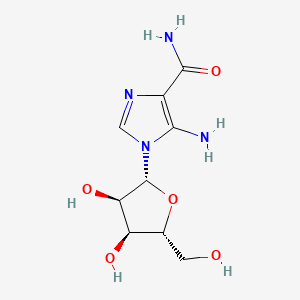
2D structure diagram from NCBI PubChem. This is the actual molecular structure of AICAR.
Description
AICAR (5-aminoimidazole-4-carboxamide-1-β-D-ribofuranoside, also known as acadesine) is a cell-permeable nucleoside analog that, upon entering cells, is phosphorylated by adenosine kinase to ZMP (AICAR monophosphate, 5-aminoimidazole-4-carboxamide-1-β-D-ribofuranosyl 5'-monophosphate). ZMP is a structural analog of AMP (adenosine monophosphate) and mimics AMP's ability to activate AMP-activated protein kinase (AMPK) — the master metabolic sensor and regulator of cellular energy homeostasis. AICAR is not a peptide; it is an adenosine analog included in the catalog for its metabolic relevance as an exercise mimetic.
AMPK is the central enzyme that detects cellular energy depletion (high AMP:ATP ratio, as occurs during exercise) and activates compensatory metabolic programs: increased glucose uptake (via GLUT4 translocation), enhanced fatty acid oxidation (via ACC phosphorylation and CPT-1 activation), mitochondrial biogenesis (via PGC-1α activation), and inhibition of energy-consuming biosynthetic pathways (lipogenesis, protein synthesis, gluconeogenesis). AICAR's ZMP metabolite activates AMPK allosterically — mimicking the cellular signal that says "you're exercising and burning energy" — triggering these metabolic adaptations without actual physical activity.
The exercise-mimetic properties of AICAR were dramatically demonstrated in a landmark 2008 study by Narkar et al. (Salk Institute, published in Cell): sedentary mice treated with AICAR for 4 weeks showed a 44% increase in running endurance compared to untreated controls, without any exercise training. This study received enormous media attention and led directly to WADA banning AICAR in 2009. AICAR was originally developed for cardiac ischemia — AMPK activation during cardiac surgery (when the heart is temporarily without blood flow) can pre-condition the myocardium and reduce ischemia-reperfusion injury. It advanced through Phase 3 clinical trials for reduction of reperfusion injury during coronary artery bypass graft (CABG) surgery, providing substantial human safety data.
Clinical Context
AICAR is the original exercise mimetic and the most extensively studied AMPK activator. Its WADA ban reflects the significant athletic performance enhancement potential of pharmacological AMPK activation. The Phase 3 cardiac surgery trial data provides a more robust human safety database than most compounds in this catalog, even though it was not ultimately approved. AICAR activates AMPK broadly throughout the body, which produces comprehensive metabolic effects but also potential off-target effects (AMPK is expressed in virtually every tissue). The 50mg vial at $29.10 represents good value for a molecule with extensive published research.
- NOT a peptide — adenosine/nucleoside analog; included for metabolic relevance
- WADA banned since 2009 — do not administer to competitive athletes subject to anti-doping testing
- Extensive human safety data from Phase 3 cardiac surgery trials — better characterized than most research compounds
- Hypoglycemia risk: AMPK activation increases glucose uptake independent of insulin — monitor blood glucose
- Lactic acidosis risk at high doses: AMPK activation can increase anaerobic metabolism
- AMPK is ubiquitous — systemic activation produces effects in all tissues, not just muscle and fat
- Potential interaction with metformin (both activate AMPK) — additive hypoglycemia risk
- Cardiac protection properties are well-established — protective in ischemia models
- Can paradoxically activate or inhibit cancer cell growth depending on cancer type and metabolic context — AMPK's role in cancer is complex
Published Research
Published Research & Clinical Data
Peer-reviewed studies and clinical trial data related to AICAR
20 from PubChem
All research below is conducted by independent institutions. MedTech Research Group provides these references for informational purposes only.
AMP-activated protein kinase, a metabolic master switch: possible roles in type 2 diabetes.
Winder WW, Hardie DG. The American journal of physiology, 1999.PMID: 10409121
The protective effect of acadesine on lung ischemia-reperfusion injury.
Matot I, Jurim O. Anesthesia and analgesia, 2001.PMID: 11226083
Jakobsen SN, Hardie DG, Morrice N, Tornqvist HE. The Journal of biological chemistry, 2001.PMID: 11598104
Acadesine: a unique cardioprotective agent for myocardial ischemia.
Nawarskas JJ. Heart disease (Hagerstown, Md.), 1999.PMID: 11720632
Senses V, Ozyazgan S, Ince E, Tuncdemir M, Kaya F, et al.. Journal of basic and clinical physiology and pharmacology, 2001.PMID: 11762693
Wojtaszewski JF, Jørgensen SB, Hellsten Y, Hardie DG, Richter EA. Diabetes, 2002.PMID: 11812734
Fryer LG, Foufelle F, Barnes K, Baldwin SA, Woods A, et al.. The Biochemical journal, 2002.PMID: 11903059
Effects of low-intensity prolonged exercise on PGC-1 mRNA expression in rat epitrochlearis muscle.
Terada S, Goto M, Kato M, Kawanaka K, Shimokawa T, et al.. Biochemical and biophysical research communications, 2002.PMID: 12163024
Horman S, Browne G, Krause U, Patel J, Vertommen D, et al.. Current biology : CB, 2002.PMID: 12194824
Fryer LG, Parbu-Patel A, Carling D. FEBS letters, 2002.PMID: 12417310
López JM, Santidrián AF, Campàs C, Gil J. The Biochemical journal, 2003.PMID: 12452797
Targeting the AMP-activated protein kinase for the treatment of type 2 diabetes.
Musi N, Goodyear LJ. Current drug targets. Immune, endocrine and metabolic disorders, 2002.PMID: 12476786
Campàs C, Lopez JM, Santidrián AF, Barragán M, Bellosillo B, et al.. Blood, 2003.PMID: 12522004
Kefas BA, Heimberg H, Vaulont S, Meisse D, Hue L, et al.. Diabetologia, 2003.PMID: 12627324
5'-aminoimidazole-4-carboxamide riboside induces apoptosis in human neuroblastoma cells.
Garcia-Gil M, Pesi R, Perna S, Allegrini S, Giannecchini M, et al.. Neuroscience, 2003.PMID: 12654334
Kefas BA, Cai Y, Ling Z, Heimberg H, Hue L, et al.. Journal of molecular endocrinology, 2003.PMID: 12683939
Møller MT, Samari HR, Fengsrud M, Strømhaug PE, øStvold AC, et al.. The Biochemical journal, 2003.PMID: 12697024
AMP-activated protein kinase plays a role in the control of food intake.
Andersson U, Filipsson K, Abbott CR, Woods A, Smith K, et al.. The Journal of biological chemistry, 2004.PMID: 14742438
Gadalla AE, Pearson T, Currie AJ, Dale N, Hawley SA, et al.. Journal of neurochemistry, 2004.PMID: 15009683
Perrin C, Knauf C, Burcelin R. Endocrinology, 2004.PMID: 15192044
4 Registered Clinical Trials
Research data sourced from ClinicalTrials.gov. Public domain (U.S. National Library of Medicine).
MedTech Research Group provides these references for informational purposes. We do not conduct original research. All studies are the work of their respective authors and institutions.
4
Total Trials
0
Recruiting
0
Active
2
Completed
Sponsor: National Center for Research Resources (NCRR)
Sponsor: Advancell - Advanced In Vitro Cell Technologies, S.A. · Completed: 2010-12
Sponsor: Groupe Francophone des Myelodysplasies · Completed: 2015-06
Sponsor: Merck Sharp & Dohme LLC · Completed: 2010-10
Research Library — 253 Papers
Research data sourced from OpenAlex. CC0 public domain. Articles are the work of their respective authors.
MedTech Research Group provides these references for informational purposes. We do not conduct original research. All studies are the work of their respective authors and institutions.
AMP-activated protein kinase—an energy sensor that regulates all aspects of cell function
D. Grahame Hardie · Genes & Development
Research by D. Grahame Hardie, published in Genes & Development. Not conducted by MedTech Research Group.
AMP-activated protein kinase mediates ischemic glucose uptake and prevents postischemic cardiac dysfunction, apoptosis, and injury
Raymond R. Russell, Ji Li, David Coven, et al. · Journal of Clinical Investigation
Research by Raymond R. Russell et al., published in Journal of Clinical Investigation. Not conducted by MedTech Research Group.
AMPK—Sensing Energy while Talking to Other Signaling Pathways
D. Grahame Hardie · Cell Metabolism
Research by D. Grahame Hardie, published in Cell Metabolism. Not conducted by MedTech Research Group.
AMPK activation: a therapeutic target for type 2 diabetes?
Asish K. Saha, Kimberly A. Coughlan, Rudy J. Valentine, et al. · Diabetes Metabolic Syndrome and Obesity
Research by Asish K. Saha et al., published in Diabetes Metabolic Syndrome and Obesity. Not conducted by MedTech Research Group.
AMP-Activated Protein Kinase: A Target for Drugs both Ancient and Modern
D. Grahame Hardie, Fiona A. Ross, Simon A. Hawley · Chemistry & Biology
Research by D. Grahame Hardie et al., published in Chemistry & Biology. Not conducted by MedTech Research Group.
Metformin inhibits melanoma development through autophagy and apoptosis mechanisms
Tijana Tomić, Thomas Botton, Michaël Cerezo, et al. · Cell Death and Disease
Research by Tijana Tomić et al., published in Cell Death and Disease. Not conducted by MedTech Research Group.
<scp>AMP</scp>‐activated protein kinase: a key regulator of energy balance with many roles in human disease
D. Grahame Hardie · Journal of Internal Medicine
Research by D. Grahame Hardie, published in Journal of Internal Medicine. Not conducted by MedTech Research Group.
AMPK: Potential Therapeutic Target for Ischemic Stroke
Shuai Jiang, Tian Li, Ting Ji, et al. · Theranostics
Research by Shuai Jiang et al., published in Theranostics. Not conducted by MedTech Research Group.
AMP-Activated Protein Kinase Inhibits Angiotensin II–Stimulated Vascular Smooth Muscle Cell Proliferation
Daisuke Nagata, Ryo Takeda, Masataka Sata, et al. · Circulation
Research by Daisuke Nagata et al., published in Circulation. Not conducted by MedTech Research Group.
The Role of AMPK Activation for Cardioprotection in Doxorubicin-Induced Cardiotoxicity
Kerstin N. Timm, Damian J. Tyler · Cardiovascular Drugs and Therapy
Research by Kerstin N. Timm et al., published in Cardiovascular Drugs and Therapy. Not conducted by MedTech Research Group.