DSIP
DSIP (Delta Sleep-Inducing Peptide)
Research Hub — Aggregated Studies
MedTech Research Group aggregates published research from peer-reviewed journals, clinical trials, and academic institutions. We do not conduct original research. All studies cited below are the work of their respective authors and institutions. Sources are linked for verification.
This product is designated FOR RESEARCH USE ONLY (RUO). These compounds have not been approved or cleared under 21 U.S.C. § 505 and have not been evaluated by the FDA for safety, efficacy, or labeling for clinical, diagnostic, or therapeutic use in humans or animals.
MedTech Research Group will only fulfill orders to qualified researchers affiliated with accredited academic institutions, licensed research facilities, or organizations with active IRB/IACUC oversight.
Purchaser Restrictions
- Purchaser must be a qualified researcher at an accredited institution or licensed research facility
- This product may not be sold or redistributed to individual consumers, wellness clinics, health food stores, or retail establishments
- Not intended for human or animal consumption, diagnostic use, or therapeutic application
- Institutional affiliation and research purpose will be verified prior to order fulfillment
Distribution is limited to qualified research use in compliance with applicable federal and state law. These products bear the "For Research Use Only" designation per FDA labeling requirements (minimum 10 pt. font). Ref: 21 U.S.C. § 505; FD&C Act § 201(p) (unapproved new drug definition).
| Risk Tier | GREEN |
| Category | Sleep |
| Subcategory | Sleep Architecture Modulation |
| Pharmacological Class | Peptide |
| Subclass | Neuromodulatory Sleep Peptide |
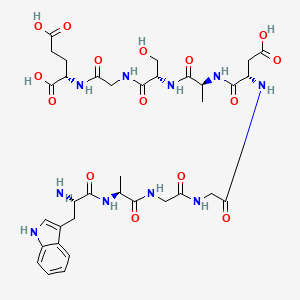
| Molecular Type | Synthetic Nonapeptide (9 amino acids: Trp-Ala-Gly-Gly-Asp-Ala-Ser-Gly-Glu) |
| Origin | Originally isolated from cerebral venous blood of rabbits during electrically induced sleep (Monnier and Schoenenberger, 1977); subsequently found to be endogenous in humans |
| Regulatory Status | Research Use Only. Not FDA-approved. Published research data from European and Russian academic institutions. |
| Route of Administration | Subcutaneous injection, intravenous (research) |
| Reconstitution | Lyophilized powder; reconstitute with bacteriostatic water |
| Storage | Refrigerate (2-8°C) |
Chemical Properties
| Molecular Formula | C35H48N10O15 |
| Molecular Weight | 848.8 g/mol |
| Exact Mass | 848.33006086 Da |
| InChI Key | ZRZROXNBKJAOKB-GFVHOAGBSA-N |
| Synonyms |
|
| PubChem | View full record |
Source: NCBI PubChem — public domain data
2D structure diagram from NCBI PubChem. This is the actual molecular structure of DSIP.
Description
DSIP (Delta Sleep-Inducing Peptide) is a naturally occurring nonapeptide first isolated in 1977 by Marcel Monnier and Guido Schoenenberger from the cerebral venous blood of rabbits during slow-wave sleep induced by low-frequency electrical stimulation of the thalamus. It was named for its ability to promote delta-wave (slow-wave) sleep when injected into the cerebral ventricles of recipient rabbits. DSIP has since been identified as an endogenous peptide in humans, present in the brain, plasma, and various peripheral tissues.
The mechanism of action of DSIP is complex and not fully elucidated, which is unusual for such an extensively studied peptide. Rather than acting as a simple sedative or sleep-inducing agent (it does not cause immediate sedation), DSIP appears to modulate sleep architecture — promoting the natural transition into slow-wave (delta) sleep and normalizing disrupted sleep patterns. Published research demonstrates multiple neuromodulatory actions: (1) modulation of GABAergic neurotransmission (enhancing GABA-A receptor function); (2) effects on serotonergic signaling (modulating 5-HT synthesis and release); (3) modulation of the hypothalamic-pituitary-adrenal (HPA) axis with stress-protective effects (reducing ACTH and cortisol responses to stress); (4) anticonvulsant properties (raising seizure thresholds); (5) analgesic effects (modulation of enkephalin/endorphin systems); and (6) normalization of circadian rhythm disruptions. Importantly, DSIP does not function as a classical hypnotic — it does not force sleep. Instead, it appears to facilitate the brain's natural sleep processes and improve sleep quality, particularly the proportion of deep, restorative slow-wave sleep.
The stress-protective properties of DSIP are particularly noteworthy. Published studies show that DSIP can reduce the physiological stress response, lower cortisol and ACTH secretion under stress conditions, normalize blood pressure in stressed subjects, and reduce stress-related muscular tension. These stress-modulating effects may partially explain its sleep benefits, as stress and hyperarousal are among the most common causes of sleep disruption.
Clinical Context
DSIP has been studied in European clinical settings (particularly in Switzerland, Germany, and Russia) for chronic insomnia, with reports of improved sleep latency, increased total sleep time, and enhanced slow-wave sleep proportion without the tolerance, dependence, or cognitive impairment associated with benzodiazepine and Z-drug hypnotics. It has also been investigated for opioid and alcohol withdrawal (where sleep disruption is a major symptom), chronic pain, and depression-related sleep disturbances. The 5mg ($17.70) and 15mg ($49.14) vials are both priced at $80 MSRP, making the 5mg vial the better per-milligram value at cost.
- NOT a sedative — does not cause drowsiness or impaired cognition; modulates sleep architecture rather than inducing unconsciousness
- No tolerance, dependence, or withdrawal reported — fundamentally different from benzodiazepines and Z-drugs
- Stress-protective effects (cortisol/ACTH reduction) contribute to sleep improvement — addresses a root cause of insomnia
- Evening administration (1-2 hours before desired sleep) is typical in research protocols
- Effects may be cumulative over several days of use rather than immediate
- Two vial sizes available: 5mg ($17.70) and 15mg ($49.14) — both at $80 MSRP
- The mechanism is not fully elucidated — DSIP appears to work through multiple neurotransmitter systems simultaneously
- Well-tolerated with minimal adverse effects; rare reports of temporary vivid dreams during initial use
- Safe to combine with melatonin or magnesium in research protocols
Published Research
Published Research & Clinical Data
Peer-reviewed studies and clinical trial data related to DSIP
5 from PubChem
All research below is conducted by independent institutions. MedTech Research Group provides these references for informational purposes only.
Flexible crosslinked benzhydryl support for gel-phase peptide synthesis.
Kumar IM, Mathew BM. Protein and peptide letters, 2002.PMID: 12141915
Characterization of a delta-electroencephalogram (-sleep)-inducing peptide.
Schoenenberger GA, Monnier M. Proceedings of the National Academy of Sciences of the United States of America, 1977.PMID: 265572
Schoenenberger GA, Maier PF, Tobler HJ, Wilson K, Monnier M. Pflugers Archiv : European journal of physiology, 1978.PMID: 568769
The influence of the delta-sleep-inducing peptide on convulsive activity.
Shandra AA, Godlevskii LS, Mazarati AM, Oleshko AA, Mikhaleva II. Neuroscience and behavioral physiology, 1993.PMID: 8232867
Shandra AA, Godlevskii RS, Vast'yanov AI, Brusentsov AI, Mikhaleva II, et al.. Neuroscience and behavioral physiology, 1996.PMID: 9121635
Research Library — 471 Papers
Research data sourced from OpenAlex. CC0 public domain. Articles are the work of their respective authors.
MedTech Research Group provides these references for informational purposes. We do not conduct original research. All studies are the work of their respective authors and institutions.
Molecular biology of the blood-brain and the blood-cerebrospinal fluid barriers: similarities and differences
Zoran Redzic · Fluids and Barriers of the CNS
Research by Zoran Redzic, published in Fluids and Barriers of the CNS. Not conducted by MedTech Research Group.
Glucocorticoids induce differentiation of a specifically activated, anti-inflammatory subtype of human monocytes
Jan Ehrchen, Lars Steinmüller, Katarzyna Barczyk, et al. · Blood
Research by Jan Ehrchen et al., published in Blood. Not conducted by MedTech Research Group.
The Circadian<i>Clock</i>Mutation Alters Sleep Homeostasis in the Mouse
Erik Naylor, Bernard M. Bergmann, Kristyn R. Krauski, et al. · Journal of Neuroscience
Research by Erik Naylor et al., published in Journal of Neuroscience. Not conducted by MedTech Research Group.
Biochemical regulation of non-rapid-eye-movement sleep
James M. Krueger · Frontiers in bioscience
Research by James M. Krueger, published in Frontiers in bioscience. Not conducted by MedTech Research Group.
Reduced orexin levels in the cerebrospinal fluid of suicidal patients with major depressive disorder
Lena Brundin, Maria Björkqvist, Åsa Petersén, et al. · European Neuropsychopharmacology
Research by Lena Brundin et al., published in European Neuropsychopharmacology. Not conducted by MedTech Research Group.
Clinical and Physiological Consequences of Rapid Tryptophan Depletion
Polly Moore · Neuropsychopharmacology
Research by Polly Moore, published in Neuropsychopharmacology. Not conducted by MedTech Research Group.
Hypothalamic regulation of sleep and arousal
Dennis McGinty · Frontiers in bioscience
Research by Dennis McGinty, published in Frontiers in bioscience. Not conducted by MedTech Research Group.
Genetic variants and abnormal processing of pre-miR-182, a circadian clock modulator, in major depression patients with late insomnia
Ester Saus, Virginia Soria, Geòrgia Escaramís, et al. · Human Molecular Genetics
Research by Ester Saus et al., published in Human Molecular Genetics. Not conducted by MedTech Research Group.
Circadian Variation in Human Milk Composition, a Systematic Review
Merel F. Italianer, E.F.G. Naninck, Jorine A. Roelants, et al. · Nutrients
Research by Merel F. Italianer et al., published in Nutrients. Not conducted by MedTech Research Group.
The Effects of Caffeine on Sleep in<i>Drosophila</i>Require PKA Activity, But Not the Adenosine Receptor
Mark N. Wu, Karen S. Ho, Amanda Crocker, et al. · Journal of Neuroscience
Research by Mark N. Wu et al., published in Journal of Neuroscience. Not conducted by MedTech Research Group.