GHRP-6 Acetate
Research Hub — Aggregated Studies
MedTech Research Group aggregates published research from peer-reviewed journals, clinical trials, and academic institutions. We do not conduct original research. All studies cited below are the work of their respective authors and institutions. Sources are linked for verification.
This product is designated FOR RESEARCH USE ONLY (RUO). These compounds have not been approved or cleared under 21 U.S.C. § 505 and have not been evaluated by the FDA for safety, efficacy, or labeling for clinical, diagnostic, or therapeutic use in humans or animals.
MedTech Research Group will only fulfill orders to qualified researchers affiliated with accredited academic institutions, licensed research facilities, or organizations with active IRB/IACUC oversight.
Purchaser Restrictions
- Purchaser must be a qualified researcher at an accredited institution or licensed research facility
- This product may not be sold or redistributed to individual consumers, wellness clinics, health food stores, or retail establishments
- Not intended for human or animal consumption, diagnostic use, or therapeutic application
- Institutional affiliation and research purpose will be verified prior to order fulfillment
Distribution is limited to qualified research use in compliance with applicable federal and state law. These products bear the "For Research Use Only" designation per FDA labeling requirements (minimum 10 pt. font). Ref: 21 U.S.C. § 505; FD&C Act § 201(p) (unapproved new drug definition).
| Risk Tier | YELLOW |
| Category | Growth Hormone Axis |
| Subcategory | Non-Selective GH Secretagogue |
| Pharmacological Class | Peptide |
| Subclass | Growth Hormone Secretagogue / Ghrelin Receptor (GHS-R1a) Agonist |
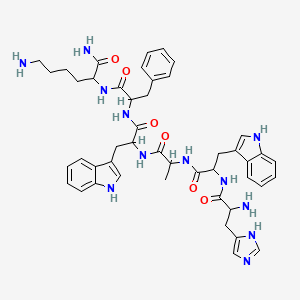
| Molecular Type | Synthetic Hexapeptide (6 amino acids: His-D-Trp-Ala-Trp-D-Phe-Lys-NH2) |
| Origin | Synthetic — one of the earliest GH secretagogue peptides developed (Bowers, 1984) |
| Regulatory Status | Research Use Only. Not FDA-approved. Extensive preclinical and some clinical pharmacology data. |
| Route of Administration | Subcutaneous injection |
| Reconstitution | Lyophilized powder; reconstitute with bacteriostatic water |
| Storage | Refrigerate (2-8°C) |
Chemical Properties
| Molecular Formula | C46H56N12O6 |
| Molecular Weight | 873.0 g/mol |
| Exact Mass | 872.44457755 Da |
| InChI Key | WZHKXNSOCOQYQX-UHFFFAOYSA-N |
| Synonyms |
|
| PubChem | View full record |
Source: NCBI PubChem — public domain data
Bioactivity Data
1 assay results from ChEMBL CHEMBL273376
| EC50 | 10.00 nM | Unchecked | — |
Data from EMBL-EBI ChEMBL. CC BY-SA 3.0.
2D structure diagram from NCBI PubChem. This is the actual molecular structure of GHRP-6 Acetate.
Description
GHRP-6 (Growth Hormone-Releasing Peptide-6) is one of the earliest synthetic growth hormone secretagogues developed, emerging from the pioneering work of Cyril Bowers in the 1980s that identified small synthetic peptides capable of stimulating GH release from the pituitary. It is a hexapeptide that acts as a potent agonist of the ghrelin receptor (GHS-R1a), the same receptor targeted by ipamorelin and endogenous ghrelin. However, unlike ipamorelin, GHRP-6 is a non-selective GHS — it activates GH release powerfully but also triggers significant secondary effects including robust appetite stimulation, mild cortisol elevation, and modest prolactin increases.
The appetite stimulation produced by GHRP-6 is its most notable distinguishing characteristic and can be either a benefit or a drawback depending on the clinical context. GHRP-6 stimulates appetite through multiple mechanisms: direct activation of GHS-R1a in the arcuate nucleus of the hypothalamus (the same receptor that ghrelin uses to drive hunger), stimulation of vagal afferents, and potentiation of neuropeptide Y (NPY) signaling. This appetite-stimulating effect is potent — many subjects report intense hunger within 20-30 minutes of injection. For patients with cachexia, wasting syndromes, or inadequate caloric intake, this can be therapeutically valuable. For patients seeking GH benefits without appetite changes, ipamorelin is the preferred alternative.
Clinical Context
GHRP-6 occupies an important historical position as one of the founding compounds in GH secretagogue pharmacology. Its non-selectivity (GH + appetite + cortisol + prolactin) represents the "first generation" of GHS compounds, with later developments (GHRP-2, hexarelin, and ultimately ipamorelin) progressively improving selectivity. In current practice, GHRP-6 is most commonly chosen when appetite stimulation is desired as a co-benefit. The cost profile is among the lowest in the GH axis category ($18.04 for 5mg, $26.68 for 10mg), making it accessible for research applications.
- Strong appetite stimulation — expect intense hunger 20-30 minutes post-injection; can be disruptive if not desired
- Mild cortisol elevation (10-20% increase) — generally not clinically significant but relevant for patients with cortisol-sensitive conditions
- Mild prolactin elevation — typically transient and not clinically meaningful at standard doses
- Non-selective pharmacology: if the patient does not need appetite stimulation, ipamorelin is preferred
- Administer on an empty stomach; food significantly blunts GH release
- Do not confuse with GHRP-2 (different peptide with intermediate selectivity)
- Lowest cost GH secretagogue option for budget-sensitive research applications
Published Research
Published Research & Clinical Data
Peer-reviewed studies and clinical trial data related to GHRP-6 Acetate
2 from PubChem
All research below is conducted by independent institutions. MedTech Research Group provides these references for informational purposes only.
Holst B, Brandt E, Bach A, Heding A, Schwartz TW. Molecular endocrinology (Baltimore, Md.), 2005.PMID: 15905359
Molecular analysis of rat pituitary and hypothalamic growth hormone secretagogue receptors.
McKee KK, Palyha OC, Feighner SD, Hreniuk DL, Tan CP, et al.. Molecular endocrinology (Baltimore, Md.), 1997.PMID: 9092793
Research Library — 2,132 Papers
Research data sourced from OpenAlex. CC0 public domain. Articles are the work of their respective authors.
MedTech Research Group provides these references for informational purposes. We do not conduct original research. All studies are the work of their respective authors and institutions.
Anorexigenic and Orexigenic Hormone Modulation of Mammalian Target of Rapamycin Complex 1 Activity and the Regulation of Hypothalamic Agouti-Related Protein mRNA Expression
Kenneth R. Watterson, Dawn Bestow, Jennifer Gallagher, et al. · Neurosignals
Research by Kenneth R. Watterson et al., published in Neurosignals. Not conducted by MedTech Research Group.
Ghrelin Causes Hyperphagia and Obesity in Rats
Alison Wren, Caroline J. Small, Caroline R. Abbott, et al. · Diabetes
Research by Alison Wren et al., published in Diabetes. Not conducted by MedTech Research Group.
Ghrelin
Timo D. Müller, Rubén Nogueiras, Mark L. Andermann, et al. · Molecular Metabolism
Research by Timo D. Müller et al., published in Molecular Metabolism. Not conducted by MedTech Research Group.
The Endocrinology of Aging
Steven W. J. Lamberts, Annewieke W. van den Beld, Aart‐Jan van der Lely · Science
Research by Steven W. J. Lamberts et al., published in Science. Not conducted by MedTech Research Group.
Growth Hormone, Insulin-Like Growth Factors, and the Skeleton
Andrea Giustina, Gherardo Mazziotti, Ernesto Canalis · Endocrine Reviews
Research by Andrea Giustina et al., published in Endocrine Reviews. Not conducted by MedTech Research Group.
Ghrelin inhibits leptin- and activation-induced proinflammatory cytokine expression by human monocytes and T cells
Vishwa Deep Dixit, Eric Schaffer, Robert Pyle, et al. · Journal of Clinical Investigation
Research by Vishwa Deep Dixit et al., published in Journal of Clinical Investigation. Not conducted by MedTech Research Group.
Antagonism of ghrelin receptor reduces food intake and body weight gain in mice
Akihiro Asakawa, A Inui, T Kaga, et al. · Gut
Research by Akihiro Asakawa et al., published in Gut. Not conducted by MedTech Research Group.
Reduced Activation and Increased Inactivation of Thyroid Hormone in Tissues of Critically Ill Patients
Robin P. Peeters, Pieter Wouters, Ellen Kaptein, et al. · The Journal of Clinical Endocrinology & Metabolism
Research by Robin P. Peeters et al., published in The Journal of Clinical Endocrinology & Metabolism. Not conducted by MedTech Research Group.
The Role of Liver-Derived Insulin-Like Growth Factor-I
Claes Ohlsson, Subburaman Mohan, Klara Sjögren, et al. · Endocrine Reviews
Research by Claes Ohlsson et al., published in Endocrine Reviews. Not conducted by MedTech Research Group.
Alterations in vitamin D status and anti-microbial peptide levels in patients in the intensive care unit with sepsis
Leo Jeng, Alexandra Yamshchikov, Suzanne Judd, et al. · Journal of Translational Medicine
Research by Leo Jeng et al., published in Journal of Translational Medicine. Not conducted by MedTech Research Group.