LL-37
LL-37 (Cathelicidin, Human Cationic Antimicrobial Peptide)
Research Hub — Aggregated Studies
MedTech Research Group aggregates published research from peer-reviewed journals, clinical trials, and academic institutions. We do not conduct original research. All studies cited below are the work of their respective authors and institutions. Sources are linked for verification.
This product is designated FOR RESEARCH USE ONLY (RUO). These compounds have not been approved or cleared under 21 U.S.C. § 505 and have not been evaluated by the FDA for safety, efficacy, or labeling for clinical, diagnostic, or therapeutic use in humans or animals.
MedTech Research Group will only fulfill orders to qualified researchers affiliated with accredited academic institutions, licensed research facilities, or organizations with active IRB/IACUC oversight.
Purchaser Restrictions
- Purchaser must be a qualified researcher at an accredited institution or licensed research facility
- This product may not be sold or redistributed to individual consumers, wellness clinics, health food stores, or retail establishments
- Not intended for human or animal consumption, diagnostic use, or therapeutic application
- Institutional affiliation and research purpose will be verified prior to order fulfillment
Distribution is limited to qualified research use in compliance with applicable federal and state law. These products bear the "For Research Use Only" designation per FDA labeling requirements (minimum 10 pt. font). Ref: 21 U.S.C. § 505; FD&C Act § 201(p) (unapproved new drug definition).
| Risk Tier | GREEN |
| Category | Immune / Thymic |
| Subcategory | Antimicrobial / Innate Immune Defense |
| Pharmacological Class | Antimicrobial Peptide (AMP) |
| Subclass | Cathelicidin Family / Human Cationic Antimicrobial Peptide |
| Molecular Type | Endogenous Peptide (37 amino acids, beginning with two leucine residues — hence "LL-37") |
| Origin | Endogenous — the only cathelicidin antimicrobial peptide in humans, derived from the C-terminal cleavage of the precursor protein hCAP18 (human Cationic Antimicrobial Protein of 18 kDa) |
| Regulatory Status | Research Use Only. Not FDA-approved. Active pharmaceutical interest in cathelicidin-based therapeutics. |
| Route of Administration | Subcutaneous injection |
| Reconstitution | Lyophilized powder; reconstitute with bacteriostatic water |
| Storage | Refrigerate (2-8°C) |
Chemical Properties
| Molecular Formula | C205H340N60O53 |
| Molecular Weight | 4493 g/mol |
| Exact Mass | 4492.5821356 Da |
| InChI Key | POIUWJQBRNEFGX-XAMSXPGMSA-N |
| Synonyms |
|
| PubChem | View full record |
Source: NCBI PubChem — public domain data
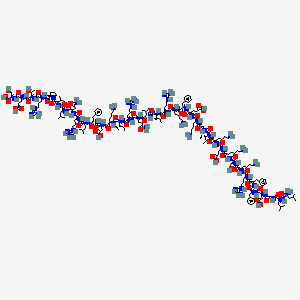
2D structure diagram from NCBI PubChem. This is the actual molecular structure of LL-37.
Description
LL-37 is the only member of the cathelicidin family of antimicrobial peptides (AMPs) found in humans. It is a 37-amino-acid cationic peptide that begins with two leucine residues (Leu-Leu, hence "LL-37") and adopts an amphipathic α-helical structure in membrane-like environments — a configuration critical to its antimicrobial mechanism. LL-37 is produced as the C-terminal fragment of the 18 kDa precursor protein hCAP18 (human Cationic Antimicrobial Protein 18), which is stored in the specific granules of neutrophils and is also expressed by epithelial cells, macrophages, monocytes, mast cells, and keratinocytes. Cleavage of hCAP18 to release active LL-37 is mediated by proteinase 3 in neutrophils and by serine proteases in epithelial cells.
The antimicrobial mechanism of LL-37 is broad-spectrum and multi-modal. The cationic (+6 net charge at physiological pH) amphipathic helix is electrostatically attracted to the negatively charged phospholipid membranes of bacteria, fungi, and enveloped viruses (mammalian cell membranes have a neutral outer leaflet and are relatively resistant). Upon membrane contact, LL-37 inserts into the lipid bilayer through the "carpet model" or "toroidal pore" mechanism, disrupting membrane integrity and causing lysis. Beyond direct killing, LL-37 has potent anti-biofilm activity — it disrupts established biofilms and prevents biofilm formation, which is significant because biofilm-associated infections (chronic wounds, implant infections, cystic fibrosis lung disease) are notoriously resistant to conventional antibiotics. LL-37 also functions as an immunomodulator: it acts as a chemoattractant for neutrophils, monocytes, and T-cells (through FPR2/ALX receptor activation), modulates dendritic cell differentiation, promotes wound healing and angiogenesis, and neutralizes bacterial lipopolysaccharide (LPS) endotoxin.
A critical regulatory aspect of LL-37 production is its dependence on vitamin D. The gene encoding hCAP18/LL-37 (CAMP) contains a vitamin D response element (VDRE) in its promoter, and its transcription is directly upregulated by 1,25-dihydroxyvitamin D₃ (calcitriol). This provides the molecular basis for the well-established link between vitamin D deficiency and increased susceptibility to infections.
Clinical Context
LL-37 is at the forefront of antimicrobial peptide therapeutics — a field gaining urgency as antibiotic resistance becomes an increasingly critical global health threat. Unlike conventional antibiotics that target specific metabolic pathways (which bacteria can evolve resistance to through single mutations), LL-37's membrane-disrupting mechanism is much more difficult for bacteria to develop resistance against (they would need to fundamentally redesign their membrane architecture). The anti-biofilm activity is particularly valuable, as biofilm infections account for over 80% of chronic bacterial infections and are a major cause of treatment failure.
- Broad-spectrum antimicrobial: effective against gram-positive bacteria, gram-negative bacteria, fungi, and enveloped viruses
- Anti-biofilm activity distinguishes LL-37 from most conventional antibiotics
- Vitamin D connection: adequate vitamin D levels are required for endogenous LL-37 production — consider vitamin D status in patients with recurrent infections
- LL-37 expression is upregulated by active vitamin D (calcitriol), infection, and inflammation
- At high concentrations, LL-37 can be cytotoxic to mammalian cells — dose selection is important
- Pro-inflammatory at some doses — may exacerbate inflammatory conditions if used inappropriately
- LL-37 overexpression has been implicated in some autoimmune/inflammatory conditions (rosacea, psoriasis) — use with caution in these populations
- Research-use peptide — no established clinical dosing protocols
Research data sourced from UniProt. CC BY 4.0 — attribution required.
MedTech Research Group provides these references for informational purposes. We do not conduct original research. All studies are the work of their respective authors and institutions.
Biological Function
Antimicrobial protein that is an integral component of the innate immune system (PubMed:14978112, PubMed:16637646, PubMed:18818205, PubMed:22879591, PubMed:9736536). Binds to bacterial lipopolysaccharides (LPS) (PubMed:16637646, PubMed:18818205). Acts via neutrophil N-formyl peptide receptors to enhance the release of CXCL2 (PubMed:22879591). Postsecretory processing generates multiple cathelicidin antimicrobial peptides with various lengths which act as a topical antimicrobial defense in sweat on skin (PubMed:14978112). The unprocessed precursor form, cathelicidin antimicrobial peptide, inhibits the growth of Gram-negative E.coli and E.aerogenes with efficiencies comparable to that of the mature peptide LL-37 (in vitro) (PubMed:9736536)
Tissue Expression
Expressed in neutrophilic granulocytes (at protein level) (PubMed:7529412, PubMed:7615076, PubMed:7890387, PubMed:8681941, PubMed:8946956, PubMed:9736536). Expressed in bone marrow (PubMed:7890387)
Subcellular Location
Secreted; Vesicle
Amino acid sequence length: 170 residues
Published Research
Published Research & Clinical Data
Peer-reviewed studies and clinical trial data related to LL-37
6 from PubChem
All research below is conducted by independent institutions. MedTech Research Group provides these references for informational purposes only.
The antimicrobial peptide LL-37 inhibits HIV-1 replication.
Bergman P, Walter-Jallow L, Broliden K, Agerberth B, Söderlund J. Current HIV research, 2007.PMID: 17627504
Ju Y, Hua J, Sakamoto K, Ogawa H, Nagaoka I. International journal of molecular medicine, 2008.PMID: 18949387
Zhou C, Qi X, Li P, Chen WN, Mouad L, et al.. Biomacromolecules, 2010.PMID: 19957992
Novel cathelicidin-derived antimicrobial peptides from Equus asinus.
Lu Z, Wang Y, Zhai L, Che Q, Wang H, et al.. The FEBS journal, 2010.PMID: 20423460
Griener TP, Strecker JG, Humphries RM, Mulvey GL, Fuentealba C, et al.. PloS one, 2011.PMID: 21731756
Urakabe S, Shirai D, Yuasa S, Kimura G, Orita Y, et al.. Comparative biochemistry and physiology. C: Comparative pharmacology, 1976.PMID: 5237
30 Registered Clinical Trials
Research data sourced from ClinicalTrials.gov. Public domain (U.S. National Library of Medicine).
MedTech Research Group provides these references for informational purposes. We do not conduct original research. All studies are the work of their respective authors and institutions.
30
Total Trials
0
Recruiting
1
Active
21
Completed
Sponsor: Fayoum University · Completed: 2023-11-15
Sponsor: Emory University · Completed: 2018-10-15
Sponsor: University of California, San Diego · Completed: 2012-12
Sponsor: Kırıkkale University · Completed: 2018-06
Sponsor: University of California, San Diego · Completed: 2021-05
Research Library — 12,115 Papers
Research data sourced from OpenAlex. CC0 public domain. Articles are the work of their respective authors.
MedTech Research Group provides these references for informational purposes. We do not conduct original research. All studies are the work of their respective authors and institutions.
Role of the normal gut microbiota
Sai Manasa Jandhyala · World Journal of Gastroenterology
Research by Sai Manasa Jandhyala, published in World Journal of Gastroenterology. Not conducted by MedTech Research Group.
Psoriasis
Frank O. Nestlé, Daniel H. Kaplan, Juliet N. Barker · New England Journal of Medicine
Research by Frank O. Nestlé et al., published in New England Journal of Medicine. Not conducted by MedTech Research Group.
The human skin microbiome
Allyson L. Byrd, Yasmine Belkaid, Julia A. Segre · Nature Reviews Microbiology
Research by Allyson L. Byrd et al., published in Nature Reviews Microbiology. Not conducted by MedTech Research Group.
Involvement of Panton-Valentine Leukocidin--Producing Staphylococcus aureus in Primary Skin Infections and Pneumonia
Gérard Lina, Y. Piémont, F. Godail-Gamot, et al. · Clinical Infectious Diseases
Research by Gérard Lina et al., published in Clinical Infectious Diseases. Not conducted by MedTech Research Group.
Evidence that Vitamin D Supplementation Could Reduce Risk of Influenza and COVID-19 Infections and Deaths
William B. Grant, Henry Lahore, Sharon L. McDonnell, et al. · Nutrients
Research by William B. Grant et al., published in Nutrients. Not conducted by MedTech Research Group.
Designing antimicrobial peptides: form follows function
Christopher D. Fjell, Jan A. Hiss, Robert E. W. Hancock, et al. · Nature Reviews Drug Discovery
Research by Christopher D. Fjell et al., published in Nature Reviews Drug Discovery. Not conducted by MedTech Research Group.
Interferon and Granulopoiesis Signatures in Systemic Lupus Erythematosus Blood
Lynda Bennett, Karolina Palucka, Edsel Arce, et al. · The Journal of Experimental Medicine
Research by Lynda Bennett et al., published in The Journal of Experimental Medicine. Not conducted by MedTech Research Group.
Endogenous Antimicrobial Peptides and Skin Infections in Atopic Dermatitis
Peck Y. Ong, Takaaki Ohtake, Corinne Brandt, et al. · New England Journal of Medicine
Research by Peck Y. Ong et al., published in New England Journal of Medicine. Not conducted by MedTech Research Group.
Psoriasis Pathogenesis and Treatment
Adriana Rendón, Knut Schäkel · International Journal of Molecular Sciences
Research by Adriana Rendón et al., published in International Journal of Molecular Sciences. Not conducted by MedTech Research Group.
Antimicrobial Peptides: An Emerging Category of Therapeutic Agents
Margit Mahlapuu, Joakim Håkansson, Lovisa Ringstad, et al. · Frontiers in Cellular and Infection Microbiology
Research by Margit Mahlapuu et al., published in Frontiers in Cellular and Infection Microbiology. Not conducted by MedTech Research Group.