Pinealon
Pinealon (Glu-Asp-Arg Tripeptide Bioregulator)
Research Hub — Aggregated Studies
MedTech Research Group aggregates published research from peer-reviewed journals, clinical trials, and academic institutions. We do not conduct original research. All studies cited below are the work of their respective authors and institutions. Sources are linked for verification.
This product is designated FOR RESEARCH USE ONLY (RUO). These compounds have not been approved or cleared under 21 U.S.C. § 505 and have not been evaluated by the FDA for safety, efficacy, or labeling for clinical, diagnostic, or therapeutic use in humans or animals.
MedTech Research Group will only fulfill orders to qualified researchers affiliated with accredited academic institutions, licensed research facilities, or organizations with active IRB/IACUC oversight.
Purchaser Restrictions
- Purchaser must be a qualified researcher at an accredited institution or licensed research facility
- This product may not be sold or redistributed to individual consumers, wellness clinics, health food stores, or retail establishments
- Not intended for human or animal consumption, diagnostic use, or therapeutic application
- Institutional affiliation and research purpose will be verified prior to order fulfillment
Distribution is limited to qualified research use in compliance with applicable federal and state law. These products bear the "For Research Use Only" designation per FDA labeling requirements (minimum 10 pt. font). Ref: 21 U.S.C. § 505; FD&C Act § 201(p) (unapproved new drug definition).
| Risk Tier | GREEN |
| Category | Neuropeptides |
| Subcategory | Brain Bioregulation / Neuroprotective |
| Pharmacological Class | Peptide Bioregulator |
| Subclass | Khavinson Peptide / Brain-Specific Tripeptide Bioregulator |
| Molecular Type | Synthetic Tripeptide (Glu-Asp-Arg, L-Glutamyl-L-Aspartyl-L-Arginine) |
| Origin | Synthetic — designed by Vladimir Khavinson (Saint Petersburg Institute of Bioregulation and Gerontology) as the brain-specific bioregulator in the Khavinson peptide system |
| Regulatory Status | Available as a dietary supplement in Russia. Not approved as a drug in any jurisdiction. Published research data from Russian academic institutions. |
| Route of Administration | Subcutaneous injection, oral (sublingual) |
| Reconstitution | Lyophilized powder; reconstitute with bacteriostatic water |
| Storage | Refrigerate (2-8°C) |
Chemical Properties
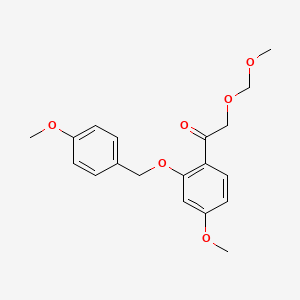
| Molecular Formula | C19H22O6 |
| Molecular Weight | 346.4 g/mol |
| Exact Mass | 346.14163842 Da |
| InChI Key | SGKMLUYJLSJRHF-UHFFFAOYSA-N |
| PubChem | View full record |
Source: NCBI PubChem — public domain data
2D structure diagram from NCBI PubChem. This is the actual molecular structure of Pinealon.
Description
Pinealon is a synthetic tripeptide bioregulator (Glu-Asp-Arg) developed by Professor Vladimir Khavinson as part of his organ-specific peptide bioregulator system. In Khavinson's framework, each tissue type has a corresponding short peptide (typically 2–4 amino acids) that can regulate gene expression in that tissue through direct interaction with DNA and histone proteins. Pinealon is designated as the brain-specific bioregulator, originally isolated from brain tissue through a process of sequential ultrafiltration and chromatographic fractionation of bovine cerebral cortex extracts.
The proposed mechanism of action, consistent with Khavinson's bioregulation theory, involves the tripeptide crossing cell membranes (short peptides can traverse lipid bilayers without requiring active transport) and entering the nucleus, where it interacts with specific DNA sequences in the promoter regions of genes related to neuronal function, neuroprotection, and brain tissue homeostasis. Published studies from Khavinson's group report that Pinealon: (1) provides neuroprotective effects against hypoxic, toxic, and ischemic neuronal damage; (2) modulates the expression of genes involved in apoptosis (reducing caspase activation under stress conditions); (3) has antioxidant properties specific to brain tissue (upregulating SOD and catalase in neurons); (4) promotes neuronal survival in cell culture models of excitotoxicity and oxidative stress; and (5) may improve cognitive function and reduce age-related cognitive decline.
Clinical Context
Pinealon, like Thymalin and Epitalon, is part of the Khavinson peptide bioregulator family — a unique approach to tissue-specific biological regulation that is widely used in Russia but has limited adoption in Western medicine. The evidence base consists primarily of Russian academic publications and preclinical studies. Despite the theoretical elegance of tissue-specific short peptide regulation, the mechanism remains debated in Western pharmacology — specifically, whether a simple tripeptide can have the specificity to selectively regulate gene expression in a particular tissue type. Pinealon is available at a moderate price ($51.56/20mg) and the larger vial size (20mg vs. the typical 5–10mg) reflects the common dosing protocols for Khavinson peptides, which typically involve multi-day courses.
- Khavinson peptide bioregulator — approved as a supplement in Russia, not as a drug in any jurisdiction
- Evidence base is predominantly from Russian academic publications; limited independent Western replication
- Typical dosing protocols follow the Khavinson pattern: multi-day courses (e.g., 10 days) repeated every 3-6 months
- Tripeptide structure is well-tolerated with minimal reported adverse effects
- The larger vial size (20mg) supports the multi-day course protocols common for bioregulators
- Consider in combination with other Khavinson bioregulators (Epitalon for pineal, Thymalin for thymus) as part of a comprehensive bioregulation protocol
- The mechanism of short peptide gene regulation is an active area of research — the specificity claims should be interpreted with appropriate scientific caution
Published Research
Published Research & Clinical Data
Peer-reviewed studies and clinical trial data related to Pinealon
All research below is conducted by independent institutions. MedTech Research Group provides these references for informational purposes only.
Research citations are being compiled for this compound.
Check back soon — our team is curating peer-reviewed sources.
Research Library — 37 Papers
Research data sourced from OpenAlex. CC0 public domain. Articles are the work of their respective authors.
MedTech Research Group provides these references for informational purposes. We do not conduct original research. All studies are the work of their respective authors and institutions.
Penetration of short fluorescence-labeled peptides into the nucleus in HeLa cells and in vitro specific interaction of the peptides with deoxyribooligonucleotides and DNA
L. I. Fedoreyeva, Igor I. Kireev, V. Kh. Khavinson, et al. · Biochemistry (Moscow)
Research by L. I. Fedoreyeva et al., published in Biochemistry (Moscow). Not conducted by MedTech Research Group.
Peptide medicines: past, present, future
V. Kh. Khavinson · Clinical Medicine (Russian Journal)
Research by V. Kh. Khavinson, published in Clinical Medicine (Russian Journal). Not conducted by MedTech Research Group.
A Comparative Study of the Effects of the Pineal Gland on Prolactin Synthesis, Storage and Release in Male and Female Blind-Anosmic Rats1
Christopher A. Leadem, David E. Blask · Biology of Reproduction
Research by Christopher A. Leadem et al., published in Biology of Reproduction. Not conducted by MedTech Research Group.
Neuroprotective Effects of Tripeptides—Epigenetic Regulators in Mouse Model of Alzheimer’s Disease
Vladimir Khavinson, Anastasiia Ilina, Nina Kraskovskaya, et al. · Pharmaceuticals
Research by Vladimir Khavinson et al., published in Pharmaceuticals. Not conducted by MedTech Research Group.
Transport of Biologically Active Ultrashort Peptides Using POT and LAT Carriers
Vladimir Khavinson, N. S. Linkova, E. O. Kozhevnikova, et al. · International Journal of Molecular Sciences
Research by Vladimir Khavinson et al., published in International Journal of Molecular Sciences. Not conducted by MedTech Research Group.
Neuroprotective Effect of EDR Peptide in Mouse Model of Huntington's Disease
Vladimir Khavinson, N. S. Linkova, E. O. Kukanova, et al. · Journal of Neurology and Neuroscience
Research by Vladimir Khavinson et al., published in Journal of Neurology and Neuroscience. Not conducted by MedTech Research Group.
Antioxidant defense system: regulation of metabolic processes, genetic determinants, methods of determination
О. А. Никитина, M. A. Darenskaya, Н. В. Семенова, et al. · Сибирский научный медицинский журнал
Research by О. А. Никитина et al., published in Сибирский научный медицинский журнал. Not conducted by MedTech Research Group.
[Neuroprotective effects of peptides bioregulators in people of various age].
Umnov Rs, N. S. Linkova, V Kh Khavinson · PubMed
Research by Umnov Rs et al., published in PubMed. Not conducted by MedTech Research Group.
Pinealon corrects hyperhomocysteinemia-induced disturbances of the diurnal dynamics of hypothalamic norepinephrine content in female rats
А. В. Кореневский, A. V. Arutyunyan, Yu. P. Milyutina, et al. · Neurochemical Journal
Research by А. В. Кореневский et al., published in Neurochemical Journal. Not conducted by MedTech Research Group.
Short Peptides Protect Fibroblast-Derived Induced Neurons from Age-Related Changes
Nina Kraskovskaya, N. S. Linkova, Elena I. Sakhenberg, et al. · International Journal of Molecular Sciences
Research by Nina Kraskovskaya et al., published in International Journal of Molecular Sciences. Not conducted by MedTech Research Group.