Semax
Semax (Met-Glu-His-Phe-Pro-Gly-Pro)
Research Hub — Aggregated Studies
MedTech Research Group aggregates published research from peer-reviewed journals, clinical trials, and academic institutions. We do not conduct original research. All studies cited below are the work of their respective authors and institutions. Sources are linked for verification.
This product is designated FOR RESEARCH USE ONLY (RUO). These compounds have not been approved or cleared under 21 U.S.C. § 505 and have not been evaluated by the FDA for safety, efficacy, or labeling for clinical, diagnostic, or therapeutic use in humans or animals.
MedTech Research Group will only fulfill orders to qualified researchers affiliated with accredited academic institutions, licensed research facilities, or organizations with active IRB/IACUC oversight.
Purchaser Restrictions
- Purchaser must be a qualified researcher at an accredited institution or licensed research facility
- This product may not be sold or redistributed to individual consumers, wellness clinics, health food stores, or retail establishments
- Not intended for human or animal consumption, diagnostic use, or therapeutic application
- Institutional affiliation and research purpose will be verified prior to order fulfillment
Distribution is limited to qualified research use in compliance with applicable federal and state law. These products bear the "For Research Use Only" designation per FDA labeling requirements (minimum 10 pt. font). Ref: 21 U.S.C. § 505; FD&C Act § 201(p) (unapproved new drug definition).
| Risk Tier | GREEN |
| Category | Neuropeptides |
| Subcategory | Nootropic / Neuroprotective |
| Pharmacological Class | Synthetic Peptide |
| Subclass | ACTH(4-10) Analog with Pro-Gly-Pro Extension |
| Molecular Type | Synthetic Heptapeptide (7 amino acids: Met-Glu-His-Phe-Pro-Gly-Pro) |
| Origin | Synthetic — designed at the Institute of Molecular Genetics, Russian Academy of Sciences; based on the ACTH(4-10) fragment with C-terminal Pro-Gly-Pro stability extension |
| Regulatory Status | Approved in Russia and several former Soviet countries as a nootropic and neuroprotective medication. Not approved in the US, EU, or other Western regulatory jurisdictions. |
| Route of Administration | Subcutaneous injection, intranasal (approved route in Russia) |
| Reconstitution | Lyophilized powder; reconstitute with bacteriostatic water |
| Storage | Refrigerate (2-8°C) |
Chemical Properties
| Molecular Formula | C83H129N19O19S |
| Molecular Weight | 1729.1 g/mol |
| Exact Mass | 1727.94328414 Da |
| InChI Key | YYQNAAKKPIDDBE-OUWAGVAFSA-N |
| PubChem | View full record |
Source: NCBI PubChem — public domain data
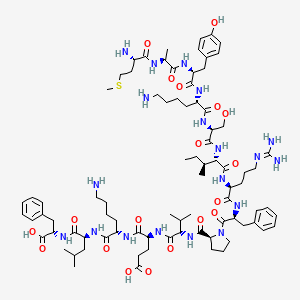
2D structure diagram from NCBI PubChem. This is the actual molecular structure of Semax.
Description
Semax is a synthetic heptapeptide analog of the ACTH(4-10) fragment — the 7-amino-acid core of adrenocorticotropic hormone (ACTH) that is responsible for ACTH's known nootropic and neurotrophic properties but NOT its adrenal-stimulating (corticotropic) effects. Full-length ACTH (39 amino acids) has two functional domains: the N-terminal region (amino acids 1-24) drives adrenal cortisol production, while the central fragment (amino acids 4-10) mediates cognitive and neuroprotective effects independently of the HPA axis. Semax uses only the ACTH(4-10) fragment (Met-Glu-His-Phe), appended with the same Pro-Gly-Pro glyproline stability extension used in Selank, to create a peptide that is nootropic and neuroprotective without any corticotropic activity — it does NOT stimulate cortisol production.
The neuroprotective and nootropic mechanisms of Semax are extensive and well-characterized in published research: (1) robust upregulation of brain-derived neurotrophic factor (BDNF) and its receptor TrkB — BDNF is the primary neurotrophic factor mediating synaptic plasticity, long-term memory formation, and neuronal survival; (2) increased expression of nerve growth factor (NGF) and neurotrophin-3 (NT-3); (3) modulation of serotonergic and dopaminergic neurotransmission; (4) antioxidant effects in brain tissue (increased superoxide dismutase and catalase activity); (5) anti-inflammatory effects in the CNS (reduced microglial activation and pro-inflammatory cytokine production); (6) improved cerebral blood flow and reduced blood-brain barrier permeability after ischemic injury. Semax has been studied as a neuroprotective agent in acute ischemic stroke, with Russian clinical studies reporting improved functional outcomes when administered within the first 12 hours of stroke onset.
Clinical Context
Semax is one of the most extensively studied nootropic peptides, with a substantial published research base from Russian academic institutions. It is approved in Russia as a nasal spray (0.1% and 1% solutions) for cognitive enhancement, acute ischemic stroke neuroprotection, and optic nerve disease. The distinction from full-length ACTH is important: Semax does NOT raise cortisol, ACTH, or aldosterone levels — it provides the cognitive benefits of the ACTH(4-10) fragment without HPA axis activation. Like Selank, it represents excellent value ($37.04/10mg at $50 MSRP) and the two are commonly used together in research and clinical practice.
- Does NOT stimulate cortisol production — uses only the nootropic fragment of ACTH, not the corticotropic region
- Approved in Russia for stroke, cognitive disorders, and optic nerve disease — extensive clinical experience
- Intranasal route is the approved delivery method; subcutaneous injection also used
- BDNF upregulation is dose-dependent and is considered the primary mechanism of cognitive benefit
- Well-tolerated with minimal adverse effects; no reported dependence, tolerance, or withdrawal
- Narrow MSRP margin ($37.04 cost vs. $50 MSRP) — same as Selank
- Commonly combined with Selank in clinical practice (anxiolytic + nootropic combination)
- Not a stimulant — cognitive enhancement does not come with sympathomimetic side effects (no jitteriness, tachycardia, or insomnia)
Published Research
Published Research & Clinical Data
Peer-reviewed studies and clinical trial data related to Semax
All research below is conducted by independent institutions. MedTech Research Group provides these references for informational purposes only.
Research citations are being compiled for this compound.
Check back soon — our team is curating peer-reviewed sources.
Research Library — 664 Papers
Research data sourced from OpenAlex. CC0 public domain. Articles are the work of their respective authors.
MedTech Research Group provides these references for informational purposes. We do not conduct original research. All studies are the work of their respective authors and institutions.
Role of Prenatal Hypoxia in Brain Development, Cognitive Functions, and Neurodegeneration
Natalia N. Nalivaeva, Anthony J. Turner, И. А. Журавин · Frontiers in Neuroscience
Research by Natalia N. Nalivaeva et al., published in Frontiers in Neuroscience. Not conducted by MedTech Research Group.
Chicken innate immune response to oral infection with Salmonella enterica serovar Enteritidis
Marta Matulová, Karolína Varmužová, Frantisek Šišák, et al. · Veterinary Research
Research by Marta Matulová et al., published in Veterinary Research. Not conducted by MedTech Research Group.
Stress-Induced Depression and Alzheimer’s Disease: Focus on Astrocytes
О. В. Долотов, Л. С. Иноземцева, N. F. Myasoedov, et al. · International Journal of Molecular Sciences
Research by О. В. Долотов et al., published in International Journal of Molecular Sciences. Not conducted by MedTech Research Group.
α‐MSH tripeptide analogs activate the melanocortin 1 receptor and reduce UV‐induced DNA damage in human melanocytes
Zalfa Abdel‐Malek, Andrew R. Ruwe, Renny Kavanagh‐Starner, et al. · Pigment Cell & Melanoma Research
Research by Zalfa Abdel‐Malek et al., published in Pigment Cell & Melanoma Research. Not conducted by MedTech Research Group.
<scp>FBXL</scp> 4 deficiency increases mitochondrial removal by autophagy
David Alsina, Oleksandr Lytovchenko, Aleksandra Schab, et al. · EMBO Molecular Medicine
Research by David Alsina et al., published in EMBO Molecular Medicine. Not conducted by MedTech Research Group.
The Developing Utility of Zebrafish Models for Cognitive Enhancers Research
Adam Stewart, Allan V. Kalueff · Current Neuropharmacology
Research by Adam Stewart et al., published in Current Neuropharmacology. Not conducted by MedTech Research Group.
Acute pancreatitis: The stress factor
Marcelo Gustavo Binker · World Journal of Gastroenterology
Research by Marcelo Gustavo Binker, published in World Journal of Gastroenterology. Not conducted by MedTech Research Group.
Natural and hybrid (“chimeric”) stable regulatory glyproline peptides
И. П. Ашмарин, Г. Е. Самонина, L. A. Lyapina, et al. · Pathophysiology
Research by И. П. Ашмарин et al., published in Pathophysiology. Not conducted by MedTech Research Group.
Astrocytes: new targets of melanocortin 4 receptor actions
Carla Caruso, Lila Carniglia, Daniela Durand, et al. · Journal of Molecular Endocrinology
Research by Carla Caruso et al., published in Journal of Molecular Endocrinology. Not conducted by MedTech Research Group.
Effects of semax and its Pro-Gly-Pro fragment on calcium homeostasis of neurons and their survival under conditions of glutamate toxicity
T. P. Storozhevykh, Г. Р. Тухбатова, Ya. E. Senilova, et al. · Bulletin of Experimental Biology and Medicine
Research by T. P. Storozhevykh et al., published in Bulletin of Experimental Biology and Medicine. Not conducted by MedTech Research Group.