Thymalin
Thymalin (Glu-Trp Dipeptide Bioregulator)
Research Hub — Aggregated Studies
MedTech Research Group aggregates published research from peer-reviewed journals, clinical trials, and academic institutions. We do not conduct original research. All studies cited below are the work of their respective authors and institutions. Sources are linked for verification.
This product is designated FOR RESEARCH USE ONLY (RUO). These compounds have not been approved or cleared under 21 U.S.C. § 505 and have not been evaluated by the FDA for safety, efficacy, or labeling for clinical, diagnostic, or therapeutic use in humans or animals.
MedTech Research Group will only fulfill orders to qualified researchers affiliated with accredited academic institutions, licensed research facilities, or organizations with active IRB/IACUC oversight.
Purchaser Restrictions
- Purchaser must be a qualified researcher at an accredited institution or licensed research facility
- This product may not be sold or redistributed to individual consumers, wellness clinics, health food stores, or retail establishments
- Not intended for human or animal consumption, diagnostic use, or therapeutic application
- Institutional affiliation and research purpose will be verified prior to order fulfillment
Distribution is limited to qualified research use in compliance with applicable federal and state law. These products bear the "For Research Use Only" designation per FDA labeling requirements (minimum 10 pt. font). Ref: 21 U.S.C. § 505; FD&C Act § 201(p) (unapproved new drug definition).
| Risk Tier | GREEN |
| Category | Immune / Thymic |
| Subcategory | Thymic Bioregulation |
| Pharmacological Class | Peptide Bioregulator |
| Subclass | Khavinson Peptide / Thymic Dipeptide Bioregulator |
| Molecular Type | Synthetic Dipeptide (Glu-Trp, L-Glutamyl-L-Tryptophan) |
| Origin | Synthetic — originally isolated from calf thymus by Vladimir Khavinson (Saint Petersburg Institute of Bioregulation and Gerontology, Russia) |
| Regulatory Status | Approved in Russia for clinical use as an immunomodulator. Not approved in the US, EU, or other Western regulatory jurisdictions. |
| Route of Administration | Subcutaneous or intramuscular injection |
| Reconstitution | Lyophilized powder; reconstitute with bacteriostatic water |
| Storage | Refrigerate (2-8°C) |
Chemical Properties
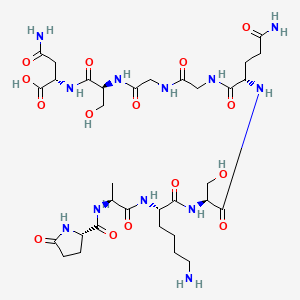
| Molecular Formula | C33H54N12O15 |
| Molecular Weight | 858.9 g/mol |
| Exact Mass | 858.38315906 Da |
| InChI Key | LIFNDDBLJFPEAN-BPSSIEEOSA-N |
| Synonyms |
|
| PubChem | View full record |
Source: NCBI PubChem — public domain data
2D structure diagram from NCBI PubChem. This is the actual molecular structure of Thymalin.
Description
Thymalin is a dipeptide bioregulator consisting of L-glutamic acid and L-tryptophan (Glu-Trp), developed by Professor Vladimir Khavinson at the Saint Petersburg Institute of Bioregulation and Gerontology as part of his broader program of organ-specific peptide bioregulators. Khavinson's bioregulation theory proposes that short peptides (typically 2–4 amino acids) derived from specific organs can regulate gene expression in the corresponding tissue through epigenetic mechanisms — interacting with DNA and histone proteins to modulate transcription patterns. Thymalin is the thymus-specific bioregulator in this system.
The proposed mechanism of action for thymalin involves the dipeptide penetrating cell membranes and entering the nucleus, where it interacts with specific DNA sequences and histone proteins to epigenetically regulate genes involved in thymic function and T-cell development. Published studies from Khavinson's group report that thymalin promotes thymic peptide production, enhances T-cell differentiation and function, restores age-related decline in thymic output, normalizes immune cell ratios, and has anti-aging effects when administered in cyclical courses. In a remarkable and widely cited longitudinal study, elderly patients treated with thymalin (combined with epithalamin/Epitalon for the pineal gland) for 6 years showed a 50% reduction in mortality compared to controls over a 12-year follow-up period (Khavinson and Morozov, 2003).
Clinical Context
Thymalin is part of the Khavinson peptide bioregulator family, which also includes Epitalon (pineal gland), Pinealon (brain), and others in this catalog. These peptides are approved and widely used in Russia but have not been subjected to the same level of randomized, placebo-controlled, Western-standard clinical trial scrutiny. The published evidence base is primarily from Russian academic institutions. Thymalin's very low cost ($22.19/10mg) and simple dipeptide structure make it an accessible entry point for thymic bioregulation research. The dipeptide nature means it is one of the smallest biologically active peptides in this catalog.
- Part of the Khavinson peptide bioregulator system — approved in Russia but not in Western jurisdictions
- Evidence base is predominantly from Russian academic publications; Western replication is limited
- Very simple structure (dipeptide) — well-tolerated with minimal reported adverse effects
- Typical research protocols use cyclical administration (e.g., 10-day courses repeated every 3-6 months)
- Much lower cost than Thymosin Alpha 1 ($22.19 vs. $78.51) — but different evidence base and mechanism
- The epigenetic mechanism proposed by Khavinson is not universally accepted — some researchers question whether a simple dipeptide can have specific organ-targeting properties
- Combine cautiously with other immunomodulators; additive immune effects are possible
Published Research
Published Research & Clinical Data
Peer-reviewed studies and clinical trial data related to Thymalin
3 from PubChem
All research below is conducted by independent institutions. MedTech Research Group provides these references for informational purposes only.
Application of thymic factor "Thymalin" in complex treatment of endometrial cancer patients.
Bakhidze EV, Bokhman JaV. European journal of gynaecological oncology, 1990.PMID: 2245808
Albericio F, van Abel R, Barany G. International journal of peptide and protein research, 1990.PMID: 2354880
An enzyme immunoassay for synthetic thymulin.
Métreau E, Pléau JM, Dardenne M, Bach JF, Pradelles P. Journal of immunological methods, 1987.PMID: 3309064
Research Library — 50 Papers
Research data sourced from OpenAlex. CC0 public domain. Articles are the work of their respective authors.
MedTech Research Group provides these references for informational purposes. We do not conduct original research. All studies are the work of their respective authors and institutions.
Natural and synthetic thymic peptides as therapeutics for immune dysfunction
В. Г. Морозов, V.Kh. Khavinson · International Journal of Immunopharmacology
Research by В. Г. Морозов et al., published in International Journal of Immunopharmacology. Not conducted by MedTech Research Group.
Peptides: Prospects for Use in the Treatment of COVID-19
Vladimir Khavinson, N. S. Linkova, Anastasiia Dyatlova, et al. · Molecules
Research by Vladimir Khavinson et al., published in Molecules. Not conducted by MedTech Research Group.
Peptides Regulating Proliferative Activity and Inflammatory Pathways in the Monocyte/Macrophage THP-1 Cell Line
Francesco Avolio, Stefano Martinotti, Vladimir Kh. Khavinson, et al. · International Journal of Molecular Sciences
Research by Francesco Avolio et al., published in International Journal of Molecular Sciences. Not conducted by MedTech Research Group.
Peptides and Ageing.
Vladimir Kh Khavinson · PubMed
Research by Vladimir Kh Khavinson, published in PubMed. Not conducted by MedTech Research Group.
Results and Prospects of Using Activator of Hematopoietic Stem Cell Differentiation in Complex Therapy for Patients with COVID-19
V. Kh. Khavinson, Kuznik Bi, Svetlana Trofimova, et al. · Stem Cell Reviews and Reports
Research by V. Kh. Khavinson et al., published in Stem Cell Reviews and Reports. Not conducted by MedTech Research Group.
Influence of peptides from pineal gland on thymus function with aging
N. S. Linkova, V. O. Polyakova, A. V. Trofimov, et al. · Advances in Gerontology
Research by N. S. Linkova et al., published in Advances in Gerontology. Not conducted by MedTech Research Group.
Thymalin: Activation of Differentiation of Human Hematopoietic Stem Cells
V. Kh. Khavinson, N. S. Linkova, I. М. Kvetnoy, et al. · Bulletin of Experimental Biology and Medicine
Research by V. Kh. Khavinson et al., published in Bulletin of Experimental Biology and Medicine. Not conducted by MedTech Research Group.
[Characteristics of the pineal gland and thymus relationship in aging].
N. S. Linkova, В О Полякова, И. М. Кветной, et al. · PubMed
Research by N. S. Linkova et al., published in PubMed. Not conducted by MedTech Research Group.
Study of the post-natal effects of chemopreventive agents onethylnitrosourea-induced transplacental carcinogenesis in rats. II. Influence oflow-molecular-weight polypeptide factors from the thymus, pineal gland, bonemarrow, anterior hypothalamus, brain cortex and brain whitesubstance
Valerij A. Alexandrov, В. Г. Беспалов, V. G. Morozov, et al. · Carcinogenesis
Research by Valerij A. Alexandrov et al., published in Carcinogenesis. Not conducted by MedTech Research Group.
FEATURES OF DEVELOPMENT OF GENERALIZED PERIODONTITIS IN PERSONS WITH SECRETORY IMMUNOGLOBULIN A DEFICIENCY AND ITS TREATMENT (LITERATURE REVIEW)
H.M. Sylenko, P. M. Skrypnykov, Yu.I. Sylenko, et al. · Wiadomości Lekarskie
Research by H.M. Sylenko et al., published in Wiadomości Lekarskie. Not conducted by MedTech Research Group.